
What OpenAI's help articles actually say about restricted topics, regulated advertisers, ad review, labelling and conversation privacy. No invented category list.
On this page
- The short version
- Who sees ads, and who does not
- Where ads do not appear
- Regulated advertiser categories: what is published and what is not
- How ad review and rejection work
- Labelling and answer independence
- Conversation privacy, in OpenAI's own terms
- OpenAI's stated advertising principles
- Ad personalisation and what it changes for advertisers
- What this means for your creative and landing page
- Common mistakes on policy and review
- UAE specifics
- Quick answers
The short version
OpenAI's public help articles do not publish a full list of restricted ad categories. What they do say clearly: ads never appear near sensitive or regulated conversations, including personal health, mental health or politics, no matter who the advertiser is. OpenAI currently does not allow political advertising at all. Some regulated advertisers, in categories such as health and financial services, can be eligible to run ads elsewhere if they meet criteria OpenAI describes as strict but does not itemise in these articles. Conversations are never shared with advertisers. If you operate in a sensitive or regulated vertical, read OpenAI's full ads policies inside Ads Manager before you build creative, because that is where the complete rules live, not in the help center.
Who sees ads, and who does not
| Account type | Sees ads |
|---|---|
| Unpaid tier | Yes |
| Go plan | Yes |
| Plus | No |
| Pro | No |
| Business | No |
| Enterprise | No |
| Edu | No |
| Any account identified as belonging to a user under 18 | No |
OpenAI determines the under 18 exclusion using "a combination of behavioral and account level signals, including stated age, how long the account has existed, typical times of use, usage patterns over time, and the general topics a person discusses," alongside account level age information where it is available. Temporary Chats never show ads, and during this test ads do not appear in the ChatGPT Atlas browser.
Where ads do not appear
OpenAI's principle, stated in its own words: "OpenAI's policy is to place ads only near chats that are safe, appropriate, and aligned with user trust and brand safety." Two specific exclusions follow from that principle.
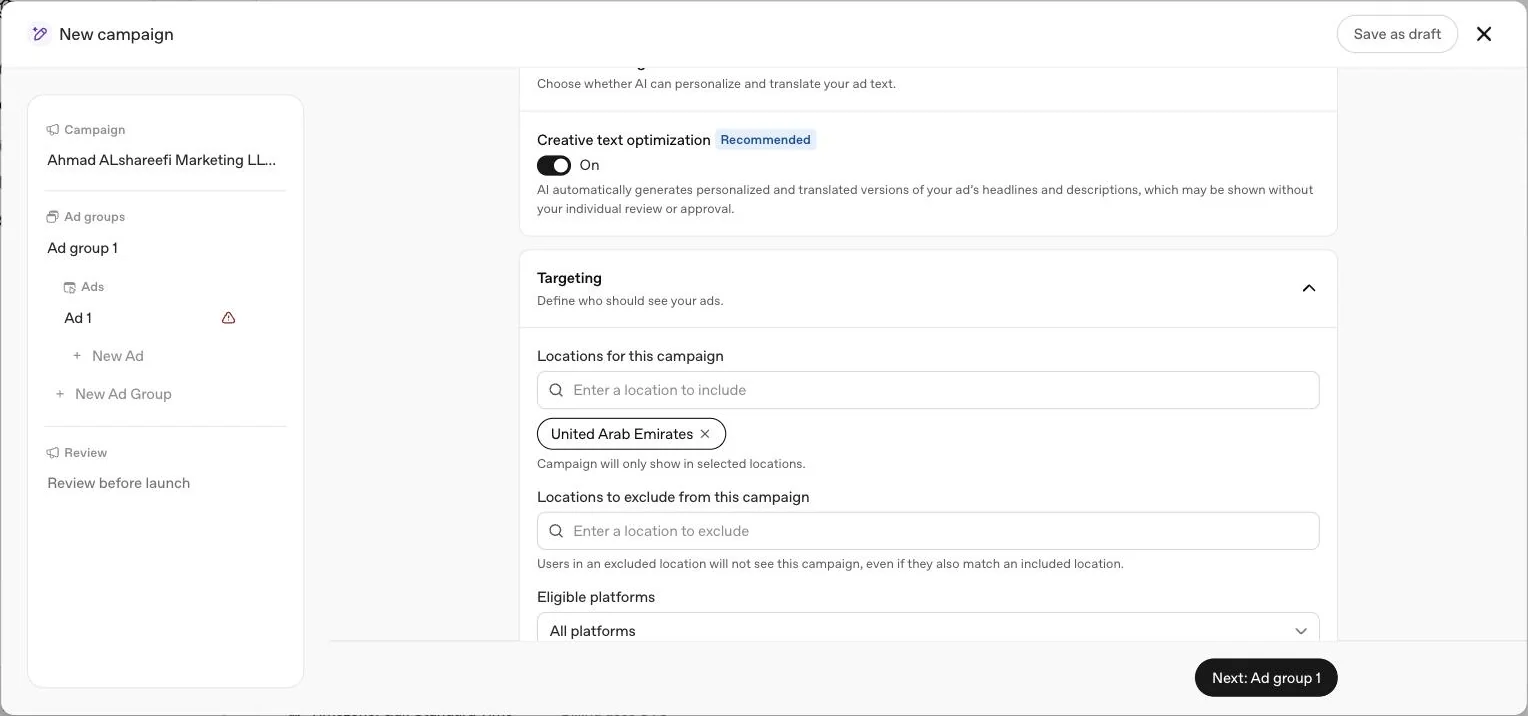
- Sensitive or regulated topics. OpenAI states plainly: "Ads are not eligible to appear near sensitive or regulated topics, including personal health, mental health, or politics." This applies regardless of who the advertiser is or whether they are otherwise eligible to run ads.
- Political advertising. OpenAI states it "currently does not allow political advertising in ChatGPT," full stop, not just near sensitive conversations.
Regulated advertiser categories: what is published and what is not
OpenAI's help articles acknowledge that some advertisers in sensitive or regulated verticals, naming health and financial services as examples, "may be eligible to advertise if they meet our strict eligibility criteria." That sentence is the extent of what these help articles say on the subject. They do not list:
- The full set of categories treated as sensitive or regulated.
- What the eligibility criteria actually require.
- Any documentation or certification process for regulated advertisers.
Even where a regulated advertiser is eligible to run ads at all, OpenAI is explicit that it still will not place those ads "near sensitive user content, including personal health conversations." Eligibility to advertise and eligibility to appear next to any given conversation are two separate gates.
How ad review and rejection work
Every ad goes through review before it can serve. In the Ads tab, an ad that has not passed shows a Not serving status; hovering over it shows OpenAI's stated reason.
| Cause OpenAI names | What it means |
|---|---|
| Ad copy or landing page does not align with OpenAI's ads policies | The specific policy that was tripped is shown in the tooltip, not published as a general list |
| Landing page blocks OpenAI's user agents or IP addresses | OAI-AdsBot or OAI-SearchBot could not reach the page, so it could not be reviewed at all |
OpenAI's own creative guidance reinforces this: "Ads may be rejected if they are misleading, inconsistent, or include disallowed content," and every "ad creative, image, and landing page must comply with OpenAI's Ads Policies." If an ad is rejected, you can edit it and resubmit for review, or request another review if you believe the decision was made in error. Our guide to ads not showing covers the fuller technical checklist, including the bot blocking issue that is easy to mistake for a policy rejection.
Labelling and answer independence
Every ad is visually separated from ChatGPT's response and carries a sponsored label. OpenAI's stated principle is "answer independence": ads do not influence ChatGPT's answers, they run on separate systems from the chat model, and advertisers "have no ability to shape, rank, or alter ChatGPT's responses." Seeing an ad is not an endorsement; OpenAI states directly that "seeing an ad doesn't mean OpenAI endorses or recommends the advertiser or its products or services."
Users can also ask ChatGPT about a specific ad through an "Ask ChatGPT" option on the ad's menu, which shares that ad into the conversation. OpenAI notes advertisers do not influence what ChatGPT says about an ad shared this way.
Conversation privacy, in OpenAI's own terms
This is the section advertisers ask about most, and OpenAI's language is unusually direct.
Sponsored Agents, an early alpha format that lets a user chat directly with an AI representative of a business inside ChatGPT, follow the same rule: the advertiser only sees what the user sends them directly inside that conversation, not the user's other ChatGPT activity. OpenAI notes Sponsored Agents are currently available only to a limited set of advertisers in an alpha test, not to self serve accounts generally.
OpenAI's stated advertising principles
OpenAI publishes a short set of principles it says guides how ads work in ChatGPT, separate from the operational policy document inside Ads Manager. In its own words, condensed to the headline of each:
Ad personalisation and what it changes for advertisers
Users on the ad eligible tiers can turn ad personalisation off at any time, and doing so does not remove ads, it narrows what informs them. With personalisation off, OpenAI says a user "will still see ads based on the context of your current chat thread," but past chat threads, ad history and browsing topics stop being used to select ads for them. Users can also view why they were shown a specific ad, hide an ad they do not want to see, and report an ad they believe is misleading, unsafe or a policy violation, which hides it and sends it to OpenAI's team for review. None of these controls give an advertiser visibility into who did what; they are entirely user side settings.
For an advertiser, the practical implication is that your context hints and ad copy have to earn relevance from the current conversation on their own merits, because a meaningful share of the audience may be seeing your ad with personalisation off. Write for the conversation in front of the user, not for an assumed profile of them.
What this means for your creative and landing page
Translating the above into practical checks before you submit an ad:
Confirm your vertical is not politically adjacent
Political advertising is not allowed at all, not just restricted near sensitive chats. If your messaging touches policy, legislation or a public official, reconsider before submitting.
Check whether you sit in a named regulated category
Health and financial services are the two categories OpenAI names explicitly. If you are in either, or something adjacent such as insurance or legal services, read the ads policies inside Ads Manager before writing creative, since the eligibility criteria are not summarised in the public help articles.
Match your landing page to your ad claim exactly
OpenAI's stated rejection cause is alignment between ad copy, landing page and its policies. A generic homepage linked from a specific claim is a common way to fail this, separate from any regulated category question.
Allow OpenAI's crawlers
A landing page that blocks OAI-AdsBot or OAI-SearchBot cannot be reviewed at all, which looks identical to a policy rejection in the Ads tab. Check firewall rules, not only robots.txt.
Common mistakes on policy and review
UAE specifics
OpenAI's published ad policies are global and do not carry country specific carve outs in the help articles we reviewed. A separate layer sits alongside them for UAE advertisers: regulated sectors here, including healthcare, financial services and real estate, usually need their own regulator's advertising approval before running any paid media, not only ChatGPT ads. That requirement comes from UAE regulators, not from OpenAI, and it applies in addition to whatever eligibility criteria OpenAI applies on its own side. If you are a clinic, a lender, an insurer or another regulated UAE business, confirm your advertising approval position with your own regulator first, and separately confirm your eligibility inside Ads Manager's ads policies before building creative. We are not qualified to state UAE regulatory specifics here, and neither of those two approvals substitutes for the other.
Quick answers
Will ChatGPT ads appear next to sensitive topics?
No. OpenAI states ads are not eligible to appear near sensitive or regulated topics, including personal health, mental health or politics, even for advertisers who are otherwise eligible to run ads.
Does OpenAI allow political advertising in ChatGPT?
No. OpenAI states it currently does not allow political advertising in ChatGPT.
Can healthcare or finance businesses advertise on ChatGPT?
Some can. OpenAI says advertisers in sensitive or regulated categories such as health and financial services may be eligible if they meet strict eligibility criteria, though OpenAI's help articles do not publish the full list of what those criteria are.
Who does not see ads on ChatGPT?
Plus, Pro, Business, Enterprise and Edu account holders, anyone identified as under 18, and anyone using Temporary Chat. Ads also do not appear in the ChatGPT Atlas browser during this test.
Do advertisers see my conversations with ChatGPT?
No. OpenAI states it does not share conversations with advertisers and never sells user data. Advertisers receive only aggregated, non identifying performance figures such as total views or clicks.
Why was my ad rejected for a policy reason?
OpenAI names two common causes: ad copy or landing pages that do not align with its ads policies, or a landing page that blocks OpenAI's crawlers. You can edit and resubmit, or request another review.
Where can I read OpenAI's full ads policies?
Inside Ads Manager itself. OpenAI's public help articles reference the ads policies repeatedly but do not reproduce the full policy text or a complete list of restricted categories, so the authoritative document lives in the product, not the help center.
Related
What ChatGPT ads are
Where ChatGPT ads appear, what an ad contains, how OpenAI picks which ad to show, who sees them, how campaigns are structured and what advertisers can never know.
Ads not showing? Fixes
Zero impressions, rejected ads, failed uploads, blocked bots and delivery that drops for no reason. Every check OpenAI lists, in the order that solves most accounts fastest.
Ad examples by UAE industry
The six parts of a ChatGPT ad, the specs OpenAI publishes, and worked example ads with five to eight context hints each for sixteen UAE industries.
Does ChatGPT have ads?
Yes. Which ChatGPT plans show ads, what the ad unit looks like, whether ads change the answers, and the settings that let you limit or avoid ads entirely.