
Context hints replace keywords in ChatGPT ads. What OpenAI says they are, how they differ from keywords and traditional targeting, five patterns and UAE examples.
On this page
- The short version
- What OpenAI asks you to describe
- The anatomy of a context hint
- The four qualities
- Context hints are not keywords
- Context hints are not traditional ad targeting either
- What hints cannot do
- Where context hints live in Ads Manager
- Five patterns for writing a strong hint
- Worked examples: B2B
- Worked examples: e-commerce
- Structuring ad groups around hints
- Hints for regulated businesses
- Seven mistakes that kill context hint performance
- Keeping hints accurate over time
- UAE specifics
- Testing and iterating on hints
- A quick test before you save
- Quick answers
The short version
A context hint is a plain sentence that tells OpenAI's system something true about your offer that the ad and landing page do not make obvious. It informs relevance. It does not control delivery, and it is not a keyword, an audience or a targeting rule, even though it sits in roughly the same part of setup where a Google Ads account would ask for keywords.
What OpenAI asks you to describe
OpenAI frames it as one question. What else should the system know about your product, who it helps and when it is useful?
| Angle | What goes in it |
|---|---|
| What | Features, services, pricing, availability, service areas |
| Who | The needs, preferences or circumstances your offer suits |
| When | The situations or decisions where it is useful |
Each hint covers one idea. It does not need all three angles. Write a natural phrase, not a string of disconnected keywords.
The anatomy of a context hint
Every strong hint, including every one OpenAI uses as its own example, is doing the same three jobs at once even when it only states one or two of them outright. It is naming a customer, a need or a moment (the who and the when), and it is tying that to a concrete detail about the offer (the what). A hint that only states the what, with no who or when attached, reads as a category description rather than a context hint, and a category description is exactly what OpenAI's specificity requirement rules out.
The four qualities below judge how well a hint executes on this structure, not a separate checklist to apply on top of it.
The four qualities
OpenAI says strong hints are additional, specific, relevant and accurate.
OpenAI's own examples of this in practice: "cushioned everyday running shoes for beginners training for their first 5K" is stronger than "running shoes" because it names the who and the when, not only the what. Elsewhere it gives "breathable running shoes for training in warm weather", which shows how a feature already on a product page becomes useful in a hint once it is tied to a reason that feature matters. And it offers "bookkeeping software for growing retailers that need to reconcile online and in-store sales" as an example of a specific customer situation rather than a generic category name like "accounting software".
Context hints are not keywords
Anyone arriving from Google Ads brings keyword habits, and those habits work against you here. A keyword is matched against a typed query. A context hint is background the system uses when judging relevance across a conversation, and OpenAI states plainly that people do not need to use your exact words for the underlying need to match. Writing ten close variants of the same phrase, the way you might build a keyword list, adds nothing a single well written hint does not already cover. Our ChatGPT ads versus Google ads guide goes further into how the two platforms differ in what they let you control.
Context hints are not traditional ad targeting either
It is worth separating hints from a second habit, one that has nothing to do with Google Ads: the demographic, interest and retargeting controls familiar from platforms like Meta. Traditional ad targeting narrows who is eligible to see an ad before relevance is even assessed, an age range, an interest category, a lookalike audience, a retargeting pool of past site visitors. A context hint does none of that. It cannot narrow eligibility at all. What it changes is how the system judges relevance once someone is already in a conversation, not who is allowed into the pool of possible viewers.
OpenAI's platform does have a real targeting layer, but it is separate from hints entirely: location targeting at the campaign level, and custom audiences, built from your own uploaded customer or prospect list, usable for inclusion, exclusion or an ad group bid multiplier. See our custom audiences guide for the eligibility rules, including the 25,000 matched user minimum for inclusion targeting. If you are trying to restrict who can see a campaign, that is the tool for the job. A context hint was never going to do it, no matter how it is worded.
What hints cannot do
This is where search habits cause the most trouble. OpenAI's wording is that hints are not targeting rules or delivery instructions, and specifically that they cannot enforce geographic limits, schedules or exclusions.
| Describes the business, fine | Delivery instruction, does not work |
|---|---|
| Residential plumbing available across Dubai and Sharjah | Show this ad only to people in Dubai |
| Open for emergency call outs after 10 pm | Only run at night |
| Built for companies with 20 to 200 staff | Exclude small businesses |
| After-hours residential plumbing with a stated service call fee | Only target people who searched for plumbers |
OpenAI's own version of this distinction uses a plumbing example: "Residential plumbing services available in Chicago" describes the business, while "Show this ad only to people in Chicago" is a delivery instruction the system will not act on. Wanting to reach a particular group does not, on its own, make your offer relevant to that group. If geography, schedule or exclusion genuinely need to be controlled, that is done through the supported targeting controls in campaign and ad group setup, covered in our Ads Manager complete guide, not through the wording of a hint.
Where context hints live in Ads Manager
Context hints sit at the ad group level, one level below the campaign and one level above the individual ad. That placement matters because it decides how a hint gets reused. Every ad inside an ad group shares the same hint set, so a hint should describe the group's shared theme, not one specific ad's angle. OpenAI does not publish a required number of hints per ad group; its developer docs say "An ad group can contain up to 2,000 hints. You do not need to fill the limit". Our practical range is two to five, each covering one distinct idea. A list that grows past that usually means the ad group is covering more than one customer need and should be split into two.
This is also why hints and ads need to be planned together rather than in isolation. An ad group with five ads and three hints is not five separate matching problems, it is one shared context, described by the hints, applied across five different creative angles on that same context. Write the hints first, once the ad group's focus is clear, then write ads that each explore a different part of the need the hints describe. If you are building the account for the first time, our account setup guide covers what has to exist before an ad group can be created at all.
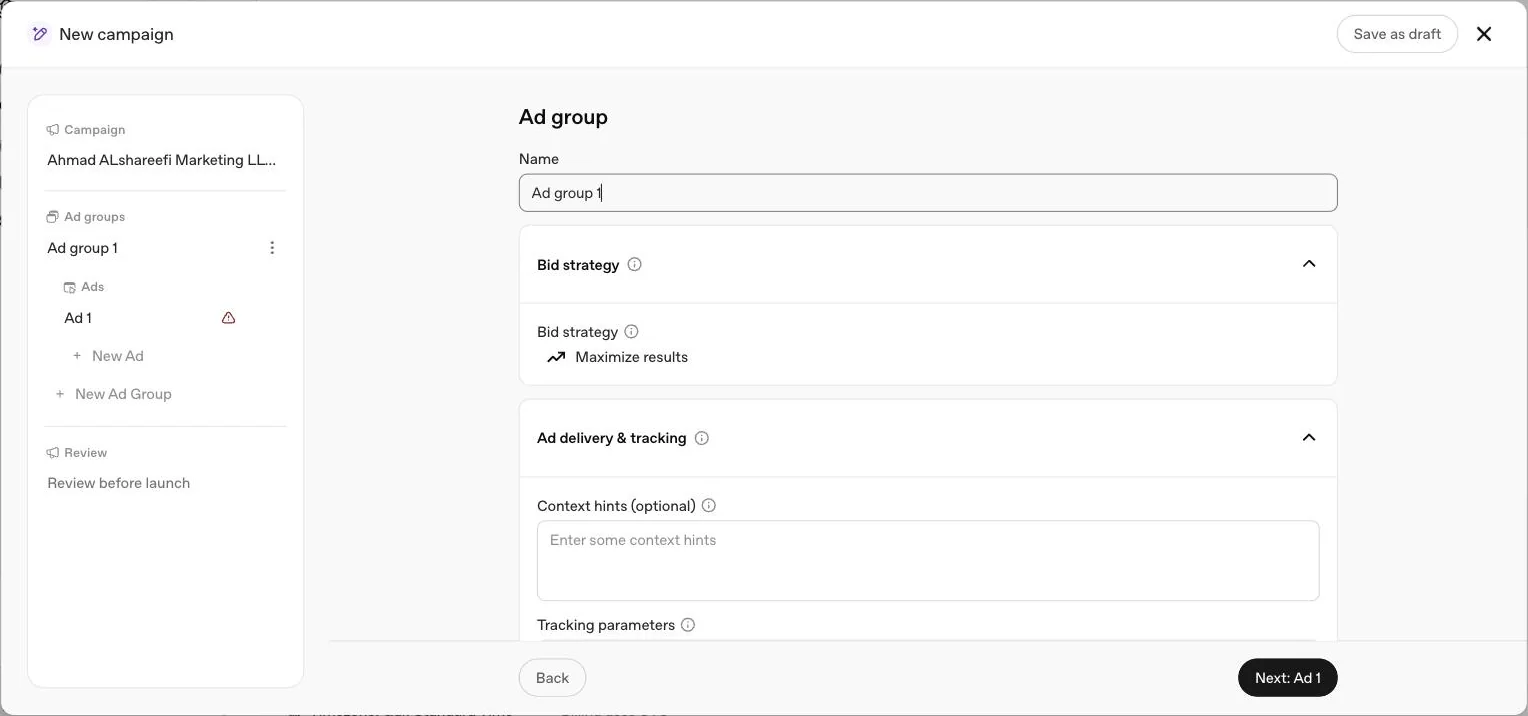
We confirmed exactly where the field sits by opening a draft campaign in our own account on 21 September 2026. In the builder's Ad group step, below Name and the Bid strategy setting, there is a section called "Ad delivery & tracking" containing a text area labelled "Context hints (optional)", placeholder text "Enter some context hints", sitting alongside Tracking parameters in the same section. Two things stand out in that screen worth knowing before you get there yourself. First, the field is explicitly marked optional, Ads Manager will let you continue to the Ad step and beyond with it empty, which is exactly why the earlier warning in this guide, that hints are not documented as mandatory but that we do not recommend leaving the field blank, matters in practice and not just in theory. Second, it sits in the same section as tracking parameters rather than near targeting, a small interface signal that OpenAI itself groups hints with delivery and measurement, not with the location and platform controls that live earlier in the Campaign step.
Five patterns for writing a strong hint
OpenAI does not publish a taxonomy of hint types. These five patterns are our own practical framework, built from applying the what, who, when structure and the four qualities above repeatedly across different kinds of business. Use them as starting shapes, not a rule from OpenAI.
A single ad group rarely needs all five patterns at once. Two or three, each covering a different real angle on the same offer, is usually a stronger set than five hints that all use the same pattern with different words.
Worked examples: B2B
| Business | Weak hint | Stronger hint |
|---|---|---|
| Accounting firm | Accounting services UAE | Corporate tax registration and filing for UAE mainland and free zone companies filing for the first time |
| B2B software | HR software | Payroll software that handles WPS files and end of service gratuity for UAE employers |
| Office fit out contractor | Office fit out Dubai | Turnkey office fit out in Dubai for 2,000 to 10,000 square feet, including building management and authority approvals |
Worked examples: e-commerce
| Business | Weak hint | Stronger hint |
|---|---|---|
| Furniture ecommerce | Sofas online | Made to order sofas delivered across the UAE in three weeks, with fabric samples sent before purchase |
| Car leasing | Car lease Dubai | Monthly car leasing for new UAE residents who do not yet have a local credit history |
| Private school | School admissions Dubai | British curriculum school in Dubai accepting mid year transfers for families relocating with more than one child |
These are illustrations written by us, following OpenAI's guidance. Use details that are true for your business. A full set of hints for 12 more UAE industries, each with six to ten hints and a matching ad headline, is in our context hint examples guide.
Structuring ad groups around hints
OpenAI's advice is to give each ad group a clear focus and to split use cases that need different messaging or landing pages. Its own example is a plumbing business running separate ad groups for emergency repairs and preventive maintenance, same company, different customer need, different messaging. A fit out firm would separate new office fit out from office refurbishment the same way. Same company, different need, different page, different hints.
Inside each group, write several ads. OpenAI says a high volume of distinct title and copy variations lets the system find more moments where you are relevant, and that each variation should bring a different angle, not repeat the same line. Our ad examples guide shows what a finished ad looks like once the hints and the creative are built together.
Hints for regulated businesses
If you sell into a regulated category, healthcare, financial services or similar, the hint writing rules do not change, but the review your ad and account go through does. OpenAI screens whether your products or services are eligible under its ads policies as part of account review, and outside the US many regulated categories are not allowed at all (see what you can and cannot advertise). Write hints that describe your actual service the same way any other business would. The extra scrutiny happens at the policy and eligibility level, not inside the hint field itself. If you are unsure whether your category is eligible at all, check before investing time in a full context hint set.
Seven mistakes that kill context hint performance
- Writing one hint that tries to cover the whole business. A hint works best tied to one ad group's single theme, not a summary of everything you sell.
- Copying competitor keywords into the hint field. A hint that could describe any competitor in the category adds nothing, since it fails OpenAI's specificity requirement.
- Phrasing a hint as an instruction. Anything that tells the system what to do, rather than what is true about the business, is treated as background, not a rule, and will not restrict delivery the way it might appear to.
- Letting a seasonal or pricing hint go stale. A hint written for a promotion that ended last month is no longer accurate, and accuracy is one of OpenAI's four stated qualities of a strong hint.
- Mixing two customer needs into one ad group's hint list. If half the hints describe one situation and half describe another, that is usually a sign the ad group should be two.
- Stating only the what, with no who or when. A hint that reads as a plain category description, with none of the situational detail covered in the anatomy section above, is the single most common weak hint we see.
- Expecting a hint to do a targeting control's job. Wanting to restrict geography, schedule or audience by rewording a hint more forcefully does not work. Use location targeting or a custom audience instead.
Keeping hints accurate over time
Treat context hints the way you would treat any other piece of live marketing copy, not a one time setup task. Whenever a price changes, a service area expands, a promotion starts or ends, or a product line is discontinued, the ad group's hints need the same update. This is easiest to manage through the bulk edit workflow covered in our bulk upload guide, since exporting an ad group for edit shows its full current hint list in one place, and OpenAI treats an uploaded hint list as a full replacement of the old one rather than an addition to it.
UAE specifics
OpenAI's context hints article does not vary by language or country, so the same what, who, when structure and the same four qualities apply whether you are writing in English or Arabic. Our approach for a UAE business running ads in both languages: write and maintain each language's hint set separately, in its own ad group, rather than mixing English and Arabic phrases inside one hint. A UAE specific detail worth naming when it is genuinely true, such as WPS payroll compliance, mainland versus free zone company setup, or a named Emirate service area, is exactly the kind of specific, accurate detail OpenAI's guidance asks for. A generic "UAE" or "Dubai" tag on its own is not, since it describes a market rather than a customer need.
If your UAE business also targets Saudi Arabia or Qatar from the same or a separate account, write a distinct hint set for each market rather than reusing the UAE set with the city name swapped. A hint that references AED pricing, a UAE authority approval, or WPS payroll is not accurate once it is applied to a Saudi Arabia targeted ad group, and accuracy is one of the four qualities OpenAI names directly.
Testing and iterating on hints
OpenAI does not publish a controlled way to A/B test one hint set against another inside a single ad group, since the hint set applies to the whole group at once rather than to one ad within it. The practical workaround we use is to duplicate the ad group, keep the ads identical, and change only the hint set between the two, then compare delivery and relevance after enough volume has run to be meaningful. This isolates the hint change from any change in creative, which a single ad group testing two ideas at once cannot do cleanly. Run this for at least a couple of weeks before drawing a conclusion, since OpenAI's own guidance elsewhere on the platform is consistent about needing enough volume before judging a change, and a short test window on a new ad group is rarely enough signal either way.
When a hint set is genuinely working, the signal is not a metric OpenAI names directly as hint attributable; it shows up as the ad group's overall relevance and delivery holding up as you add more ads to it. If delivery on a well built ad group still feels thin, revisit the hints before assuming the creative is at fault, since a hint set that is too narrow or too generic limits how much relevance the system can find regardless of how many ad variations you add underneath it.
A quick test before you save
Read the hint aloud. If it could describe any competitor, it is too generic. If it tells the system to do something, it is an instruction and will be ignored. If it names no who and no when, it is a category label rather than a context hint. If it would be false next month, put a reminder in the calendar to change it.
Quick answers
Are context hints keywords?
No. OpenAI says they are not exact match keywords or targeting rules, and they do not guarantee delivery for particular conversations or audiences.
Can a context hint limit my ads to Dubai?
No. OpenAI says hints cannot enforce geographic limits, schedules or exclusions. Describing your service area is fine. Restricting delivery needs the supported targeting controls, such as location targeting or a custom audience.
Where do I add context hints?
At ad group level, not the campaign or the individual ad. Group hints around one product, service, theme or customer need, and use separate ad groups when a use case needs different messaging or a different landing page.
How often should hints change?
Whenever features, pricing, promotions, availability or service areas change. OpenAI lists accuracy as one of the four qualities of a good hint, and an outdated hint stops being accurate the moment the underlying offer changes.
How many context hints does one ad group need?
OpenAI does not publish a minimum. Its developer docs set a ceiling of up to 2,000 hints per ad group and add that you do not need to fill the limit. Our approach is two to five per ad group, each covering one distinct idea, since a longer list starts covering more than one theme and usually signals the ad group should be split.
Do context hints work differently for Arabic language ads?
OpenAI's article does not distinguish by language. The same what, who, when structure and the same four qualities apply whether the hint is written in English or Arabic.
What is the difference between a context hint and a custom audience?
A context hint describes your offer in words, to help the system judge relevance inside a conversation. A custom audience is a list of your own customers or prospects, uploaded by email, phone or hashed identifier, used to include or exclude specific people from delivery. They work at different layers and are not substitutes for each other.
Can I copy my Google Ads keyword list into context hints?
You can, but it usually performs worse than writing hints fresh. A keyword list is built for exact or close phrase matching against a typed query. A context hint needs to read as a natural sentence describing what, who and when, and a raw keyword list rarely reads that way.
Do context hints affect my bid or my cost?
OpenAI does not document a direct price effect from a hint. What it does say is that relevance affects the auction, and a hint that makes your ad genuinely more relevant to real conversations can improve the outcome you get for a given bid, without hints themselves being priced.
What happens if I leave the context hints field empty?
OpenAI's guidance frames hints as additional context you provide, not a mandatory field description with its own minimum. In practice we do not recommend leaving it empty, since the ad and landing page then carry the entire relevance signal on their own.
Related
Context hint sets by industry
A full context hint set for 20 UAE industries, each with the matching ad headline and a note on what to avoid, built from OpenAI's context hint rules.
ChatGPT Ads Manager guide
ChatGPT Ads Manager, also called OpenAI Ads Manager, explained level by level: account, campaign, ad group and ad, what cannot be edited later, and a launch checklist.
What ChatGPT ads are
Where ChatGPT ads appear, what an ad contains, how OpenAI picks which ad to show, who sees them, how campaigns are structured and what advertisers can never know.
Account setup
How sign up works in OpenAI Ads Manager today, what a UAE business should prepare, what the Beta looks like once access is granted, and why campaigns still don't serve.
Custom audiences
How to build a custom audience from a customer list, the 25,000 user minimum for inclusion targeting, exclusion rules and audience bid multipliers, from OpenAI's own article.
ChatGPT ads vs Google Ads
Targeting, auction, formats, measurement and budgets compared side by side, and how a UAE company should split a test budget between the two.