
Where ChatGPT ads appear, what an ad contains, how OpenAI picks which ad to show, who sees them, how campaigns are structured and what advertisers can never know.
On this page
- The short version
- What an ad contains
- What we saw setting up our own account
- Where ads appear
- How OpenAI picks the ad
- How pricing and billing work, in brief
- The three levels of a ChatGPT ads account
- Writing context hints, the replacement for keywords
- Who sees ads
- What advertisers can and cannot know, and what users control
- How a person can reduce or avoid seeing ads at all
- Key terms at a glance
- Beyond the standard ad unit
- Brand safety and ad review
- What might change while the platform is in beta
- What OpenAI has not published
- What this means for how you advertise
- Common mistakes when learning the format
- Should you run ChatGPT ads right now?
- Getting started
- UAE and Gulf specifics
- What to do this week
- Quick answers
The short version
A ChatGPT ad is a clearly labelled paid unit shown below an answer. OpenAI's system chooses it from the context of the conversation, your ad, your landing page and the context hints you supply, then ranks eligible ads by relevance and bid. You pay per thousand impressions or per valid click. You never see the conversation, and the advertiser never does either.
What an ad contains
OpenAI lists six parts in every standard ad.
| Part | What it is |
|---|---|
| Advertiser name | The Brand Name set in Settings, then General |
| Favicon | Your logo, also set in Settings, then General |
| Title | The headline |
| Copy | The description |
| Landing page | Where the click goes |
| Image asset | The creative |
OpenAI lists confirming your logo and account names in Settings, then General among the steps to finish before campaigns start delivering, and the Brand Name you set there is the public name shown alongside your ads.
What we saw setting up our own account
Opening our own Ads Manager account made the logo and billing requirement concrete rather than abstract. The Overview screen showed a Tasks row with four items for an unfinished account, including "Finish billing setup" and "Upload account logo," both marked Required, alongside a banner reading "Ads cannot serve until you finish account setup. Set up billing and upload an account logo to start serving ads." The left navigation split into Overview, Campaigns, Tools, Billing and Settings, with Tools expanding into Conversions, Feeds, Change History and Audiences. The Campaigns screen carried its own timezone selector, showing Gulf Standard Time, with a footer note reading "Billing uses UTC," a small but real gap worth knowing about before comparing a daily spend figure against your own clock. None of this changes what OpenAI's help articles state, it simply confirms the account setup requirement is enforced in the interface itself, not just documented.
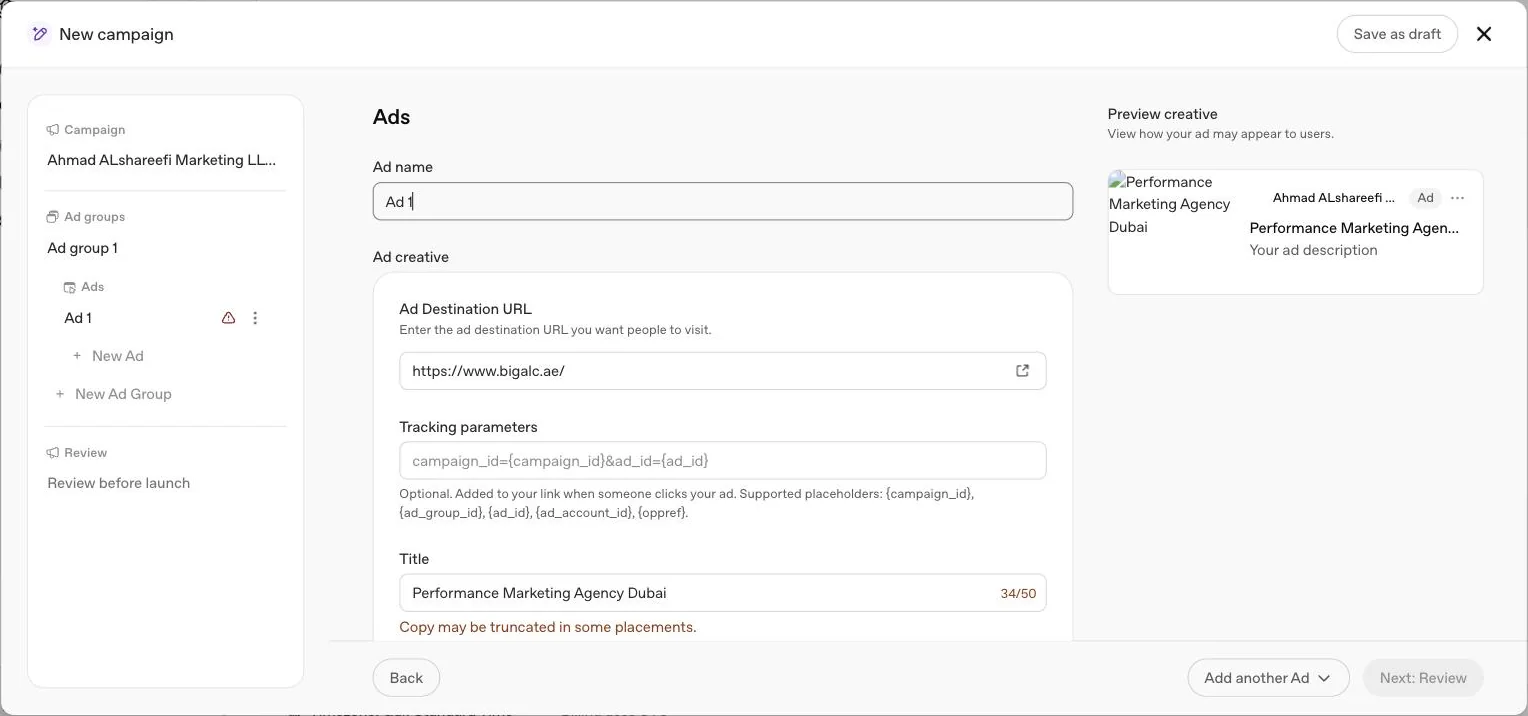
Opening the campaign builder itself surfaced a fact not covered anywhere in OpenAI's published help articles at the time of writing: a campaign draft opened already pre-filled, AI generated, from the account's own details, with a "Create from scratch" option shown alongside it, and a toggle called "Creative text optimization," tagged "Recommended" and switched On by default, carrying the description "AI automatically generates personalized and translated versions of your ad's headlines and descriptions, which may be shown without your individual review or approval." The Title field showed a live counter against a 50 character limit, already flagging "Copy may be truncated in some placements" at 34 of 50 characters, and the Description field showed a 100 character counter with a minimum length validation. Context hints sat in the ad group step, labelled "Context hints (optional)." None of this contradicts OpenAI's help centre articles, which do not currently describe the Creative text optimization toggle at all, but it does mean the account level behaviour is more automated by default than the help documentation alone would suggest.
Where ads appear
Ads can appear below a ChatGPT response. They are clearly labelled and shown separately from the answer. OpenAI says a person will see one ad unit that may contain one or multiple images below a response. OpenAI is also testing a multi image visual ad format during image generation: an ad with several images from the same advertiser can appear while ChatGPT creates an image, and it disappears once the image finishes generating.
Ads do not appear in Temporary Chats. OpenAI also says ads are not eligible to appear near sensitive topics, including personal health, mental health and politics, and that it does not currently allow political advertising.
How OpenAI picks the ad
OpenAI says its ads system selects ads based on expected relevance and outcomes. The signals it names are:
- the context and intent of the current conversation
- the ad's landing page, title and copy
- advertiser provided context hints and targeting selections
- when the user has ads personalisation switched on, select signals from their wider ChatGPT experience
When several ads are eligible, ranking combines relevance with advertiser bids. OpenAI describes the auction as relevance weighted and second price, and says its system aims to maximise both advertiser and user value.
This is the main difference from search advertising. You do not buy a keyword. You describe your offer well enough that the system can tell when it is useful, then you bid.
How pricing and billing work, in brief
A campaign's objective fixes how you pay, and OpenAI says the objective and billing option cannot be changed in place after the campaign is created. Choose Views to buy on cost per thousand impressions (CPM) and optimise for reach. Choose Clicks to buy on cost per click (CPC) and optimise for traffic, billed per valid click. Choose Conversions to optimise delivery toward one selected supported conversion event, billed either per valid click (oCPC) or per thousand impressions (oCPM), never per conversion itself. Billing is postpaid: spend accrues as ads deliver, and for a self service, card billed account, the saved card is charged once accrued spend reaches an assigned payment threshold, or at month end for any remaining balance. Every account also has a minimum daily budget set by its billing currency, for example AED 65 a day for an AED billed account. As a pure arithmetic illustration on that published figure, not a recommendation, a campaign left at that exact minimum for a full 30 day month would average out at about AED 1,950 over the month, equivalent to roughly USD 530.97 at 3.6725, a currency conversion only. Actual spend can run lower on quiet days and higher on strong ones, since a daily budget is an average over a seven day period, not a same day cap. Our ChatGPT ads cost guide covers the full pacing rule and bid mechanics, and billing covers the payment threshold and invoicing detail.
The three levels of a ChatGPT ads account
Every campaign in Ads Manager follows the same structure, and understanding it before you build anything saves a rebuild later.
| Level | What it defines | What lives here |
|---|---|---|
| Campaign | Objective, billing model, budget, dates, country and platform targeting | The overall goal. Objective and billing option cannot be changed in place once the campaign is created |
| Ad group | Theme, intent and context hint clusters, and the bid | Context hints that describe what you offer, who it helps and when. Bid strategy is also set here |
| Ad | The creative unit | Title, copy, image, landing page and any UTM or dynamic URL parameters |
OpenAI recommends creating multiple ad groups within a campaign to test different themes or value propositions, and multiple ads within each ad group so its system can find more moments where your offer is relevant. A single ad account can hold up to 5,000 campaigns, 5,000 ad groups and 5,000 ads.
Writing context hints, the replacement for keywords
At ad group level you can add context hints, natural language phrases that describe the conversations, topics or situations where your product or service is relevant. OpenAI frames the exercise as three questions: what you offer, who it helps, and when it is useful. A hint does not need to answer all three.
OpenAI's own example: "cushioned everyday running shoes for beginners training for their first 5K" tells the system more than the phrase "running shoes" alone. A hint should add something not already obvious from your ad or landing page, describe a concrete feature or situation, and stay accurate as your offering changes.
What hints are not: delivery instructions. OpenAI is explicit that hints cannot enforce geographic limits, schedules or exclusions, and that people do not need to type your exact words for the underlying need to match. "Residential plumbing services available in Chicago" describes the business. "Show this ad only to people in Chicago" is a delivery instruction, and only supported product controls, not hints, can do that. Read the full method in writing context hints for ChatGPT ads.
Who sees ads
Ads may appear for people on ChatGPT's unpaid tier and the Go plan. Plus, Pro, Business, Enterprise and Edu accounts do not have ads. OpenAI does not show ads to accounts identified as belonging to people under 18, based on account level age information and age prediction where available.
For a UAE advertiser this means the audience is the large unpaid user base and the entry level paid plan, not the power users on higher plans. Plan your offers with that in mind, and see ChatGPT ads in the UAE for what that means for account setup and budgets locally.
What advertisers can and cannot know, and what users control
OpenAI is direct about this. Advertisers do not have access to chats, chat history, memories or personal details. Advertisers receive aggregated, non identifying information about how ads perform, such as total views or clicks. If a person chooses to message an advertiser through an ad, the advertiser sees only the messages sent to them directly.
Ads run on systems separate from the chat model, and OpenAI states that advertisers cannot shape, rank or alter ChatGPT's responses. Reporting in Ads Manager currently covers impressions, clicks, spend, click through rate, average CPC, average CPM and conversions where measurement is set up. See measuring ChatGPT ads results for how that reporting works in practice.
Users can also switch ads personalisation off, dismiss ads, see why an ad was shown and clear the data used for ads. With personalisation off, a person still sees ads based on the current chat thread, but other threads, ads history and topics are not used. Personalised ads were not initially available in the European Economic Area or Switzerland.
How a person can reduce or avoid seeing ads at all
This matters to an advertiser because it shapes exactly who your ad can actually reach. OpenAI gives unpaid tier users an explicit choice between two experiences: stay on the ad supported unpaid tier, or switch to a no-ads option that removes ads in exchange for lower usage limits and reduced feature access, such as fewer messages and no access to some tools. A person can switch between the two from Settings, Ads controls, and OpenAI shows a prompt explaining the trade-off each time. Anyone on Plus or Pro already has no ads at all, by plan design, not by opting out. On top of that, a three dot menu on any ad lets a person hide it, report it if they believe it is misleading or unsafe, see why they were shown it, or share it with ChatGPT to ask questions, and reporting an ad both hides it for that person and sends it to OpenAI's review team. None of these controls are something an advertiser can see or override. The practical takeaway is that your addressable audience on ChatGPT ads is smaller than "everyone who uses ChatGPT," since it excludes every paid Plus and Pro account by definition and some share of unpaid tier users who deliberately choose the reduced-limits no-ads option.
Key terms at a glance
| Term | What it means here |
|---|---|
| Context hint | A natural language phrase at ad group level describing what you offer, who it helps or when it is useful. Not a keyword |
| oCPC | Conversion-optimised campaign billed per valid click, optimising delivery toward a chosen conversion event |
| oCPM | Conversion-optimised campaign billed per thousand impressions, optimising delivery toward a chosen conversion event across a broader set of eligible signals |
| Relevance weighted, second price auction | How OpenAI describes the ranking method that combines an ad's relevance with the advertiser's bid |
| Serving / Not serving | An ad's live status in Ads Manager. Not serving shows a reason on hover, most often a policy or landing page issue |
| oppref | OpenAI's click reference, appended to a landing page URL, used to connect a later conversion back to the ad click that produced it |
This is a working shortlist, not the full vocabulary. Our ChatGPT ads glossary covers every term used across Ads Manager in one place.
Beyond the standard ad unit
The standard six part unit is what almost every advertiser buys today, but it is not the only one. A product feed campaign builds ads directly from an uploaded product catalogue rather than a single hand written ad, showing image, title, stars, price, sale price and brand per item. OpenAI says ads created from product feeds have been among the strongest performing ads in its programme to date, which makes sense given they scale with a catalogue instead of requiring one ad per product written by hand. Our product feed guide covers the build, and ChatGPT ads for ecommerce covers when a feed campaign fits better than standard ads.
OpenAI's help centre also describes Sponsored Agents, a format in limited alpha test that lets a person open a chat with an AI representative of a business from inside an ad. It is not available for general advertiser purchase, and OpenAI is not accepting early access requests. We cover what is published about it in Sponsored Agents in ChatGPT ads.
Brand safety and ad review
OpenAI states its policy is to place ads only near chats that are safe, appropriate and aligned with user trust and brand safety, and that its safeguards are designed to prevent ads appearing in sensitive user contexts or brand unsafe environments. Every ad goes through review before it can serve. In Ads Manager, an ad's status shows whether it is Serving or Not serving, and hovering over Not serving gives the reason, most often a landing page or creative that does not meet OpenAI's ads policies, or a landing page that blocks OpenAI's crawlers. A rejected ad can be edited and resubmitted, or you can request another review if you believe it was rejected in error. OpenAI also says qualifying advertisers can use Negative Phrases for narrow placement requirements specific to their brand's own policies, an option not necessarily available to every advertiser.
What might change while the platform is in beta
Ads Manager carries a Beta label for a reason. OpenAI states directly that it expects to keep evolving delivery systems, inventory, ad formats, and how advertisers buy, manage, measure and optimise campaigns during this period, and that ongoing changes to delivery systems and models can cause delivery and spend to fluctuate even when an account's own settings have not changed. For conversion optimised campaigns specifically, OpenAI states its goal is to improve conversion outcomes, not simply to use the full budget, which is a different mindset from a mature ad platform where stable delivery is the baseline expectation. Two practical consequences follow from this. First, a week over week swing in delivery is not automatically a sign that something in your account is broken; check the basics in our ChatGPT ads not showing guide before assuming so. Second, treat any specific number you read about the platform, including the figures in this guide, as accurate on the verified date shown at the top of the page, and check OpenAI's current help centre articles before relying on it for a decision with real budget behind it.
What OpenAI has not published
- No published performance benchmarks across advertisers, industries or campaign types. OpenAI states this directly, and it is the reason nobody, including an agency, can honestly guarantee a specific cost per lead.
- No published average CPC or CPM for the UAE or any other market. OpenAI's only public price signal is a suggested starting bid range for CPC campaigns, quoted in US dollars as a starting point, not a market average.
- No published limit on how many images one ad unit can carry; OpenAI says only that a person will see one ad unit that may contain one or multiple images below a response.
- No published detail on how the relevance weighted, second price auction actually weighs relevance against bid, beyond stating that both are considered.
- No published timeline for when Sponsored Agents, or other formats beyond the standard unit and product feed ads, might open to general advertisers.
- No published description of the Creative text optimization toggle at all, despite it being on by default when we saw it in our own account on 21 September 2026. Anything beyond what we saw on screen, how variations are chosen, how often, or whether they are logged anywhere for later review, is unknown.
What this means for how you advertise
Three habits carry over badly from search, and three replace them.
| Search habit | ChatGPT ads habit |
|---|---|
| Build keyword lists | Write context hints that describe what you offer, who it helps and when |
| One best headline | Many distinct title and copy variations, each with a different angle |
| Send traffic to the homepage | Send each ad to the page that answers that specific need |
OpenAI's own creative guidance says to build for coverage, keep variations distinct, be specific and useful, and represent the offer accurately. Landing pages must be reachable and must not block OpenAI's user agents, OAI-AdsBot and OAI-SearchBot.
Common mistakes when learning the format
- Treating context hints as a keyword list. Pasting ten short keywords into the hints field misses the point. OpenAI wants one clear phrase per idea, not a list.
- Writing one ad per ad group. OpenAI's guidance is explicit that coverage from many distinct variations helps its system find more relevant moments. One ad is a search-era habit.
- Assuming an ad influences the answer. It does not, and OpenAI states this plainly. If you want ChatGPT to mention your brand in an organic answer, that is a separate question about how your content is written and crawled, not an outcome ads can buy.
- Skipping the logo, Brand Name and billing. OpenAI lists billing, the logo and the account names among the steps to finish before campaigns start delivering, and the logo and Brand Name are what identify you inside every ad unit.
- Assuming a live campaign can be switched to a Conversions objective later. OpenAI does not allow the objective or billing option to change in place after a campaign is created. Build a new campaign, or use OpenAI's clone option where it offers one, instead of trying to edit an existing campaign into a different objective.
- Reading a quiet Thursday as a delivery problem. A daily budget is an average over a seven day period in the account's timezone, not a same day cap, so a single slow day inside a pacing week is expected behaviour, not necessarily a fault.
Should you run ChatGPT ads right now?
There is no single yes or no answer OpenAI publishes, since eligibility and results depend on your own setup. The table below is how we think through the decision with a business that is not yet sure.
| Factor | Leans toward running it now | Leans toward waiting |
|---|---|---|
| Offer type | One clear, specific offer you can describe in a sentence | Several unrelated offers with no obvious place to start |
| Budget | Comfortable spending meaningfully above the AED 65 a day floor for several weeks | Only able to test at or near the AED 65 a day minimum with no room to grow it |
| Tracking readiness | A working way to see which leads actually turn into sales, in a CRM or equivalent | No reliable way yet to connect a lead or click to a real outcome |
| Regulated category | Not in a category OpenAI's eligibility table lists as not allowed or restricted outside the US | In health, legal, financial services or another category that OpenAI's eligibility table lists as not allowed, or restricted to select approved advertisers, outside the US |
| Sales cycle | Short enough that a few weeks of data starts to show a pattern | Long enough, months rather than weeks, that a short test cannot show a real result yet |
A business that leans toward waiting on most of these is not disqualified from ChatGPT ads. It usually just needs to fix the specific gap, tracking, category eligibility, offer focus, before spend starts, rather than run a test that cannot produce a judgable answer.
Getting started
The fastest path is Ads Manager's guided flow.
- Create your Ads Manager account, set up billing, and confirm your logo and Brand Name in Settings, then General, since the Brand Name is the public name shown alongside your ads.
- Create a campaign and choose an objective: Views, Clicks or Conversions. This choice fixes the billing model, so decide it deliberately.
- Create ad groups inside the campaign, grouped by a shared product, service or customer need, and write context hints for each.
- Create ads inside each ad group: title, copy, image and landing page, with UTM parameters on the destination URL.
- Submit for review, then monitor the Serving status and early impressions and clicks once the campaign is live.
For a full account setup walkthrough, see setting up a ChatGPT Ads Manager account. If you are choosing between doing this yourself and hiring it out, what to ask a ChatGPT ads agency covers the questions worth asking before you hand over the account.
UAE and Gulf specifics
Nothing about the ad format changes for a UAE advertiser, but the setup does. Bill the account in AED if the advertising entity is UAE based, since the minimum daily budget and currency are set once at account creation and cannot be changed afterwards. Write separate ads for Arabic and English rather than one bilingual unit, because each ad carries a single title and copy, and OpenAI says ad language selection considers the user's location, language settings and conversation language. Build context hints in the language your customer would actually type or say to ChatGPT, not a direct translation of your English hint, since a literal translation often keeps an English sentence structure a Gulf Arabic speaker would not actually use.
The budget week that OpenAI paces spend against runs Sunday to Saturday in the account's time zone, which only partly overlaps a Sunday to Thursday Gulf working week, so a Thursday spend check will always be mid cycle. As a worked illustration, not a platform statement: a campaign that spends most of its weekly allowance across its Sunday to Wednesday peak and pulls back on Thursday is still behaving normally under OpenAI's seven day average rule, since a daily budget can run up to twice its figure on a strong day and less on a quiet one, so long as the full week does not exceed seven times the daily amount. Reading that pattern as a delivery problem on a Thursday afternoon check is a common, avoidable misread. For the fuller UAE setup path, including account ownership and a four week test plan, see ChatGPT ads in the UAE.
What to do this week
- Confirm your category against OpenAI's ads policies before you apply, especially if you operate in health, financial services or another regulated area.
- Create the Ads Manager account for your own business entity, since OpenAI requires the legal entity that will advertise and be billed to be based in an available country, and its setup guide says to have one person create the account, then invite anyone else who needs access.
- Set up billing and confirm the logo and Brand Name in Settings, then General as soon as the account exists, since OpenAI lists these among the steps to finish before campaigns start delivering.
- Set up a simple way to see which leads actually become sales, even a manual CRM note, before any campaign spends a dirham.
- Write one ad group for your single clearest offer, following the what, who, when method in our context hints guide, rather than trying to cover the whole business at once.
- Decide your billing currency deliberately, since OpenAI says country or region, currency and time zone cannot be changed after account creation; budget amounts can be changed later.
- If you are still deciding whether to run this yourself, read what to ask before hiring a ChatGPT ads agency before you hand access to anyone.
Quick answers
Where do ChatGPT ads appear?
Below a ChatGPT response, clearly labelled and shown separately from the answer, in one ad unit that may contain one or multiple images. OpenAI is also testing a multi image ad format shown while ChatGPT generates an image.
Can I target keywords in ChatGPT ads?
Not in the search ads sense. You write context hints at ad group level that describe when your offer is relevant. OpenAI says they are not exact match keywords and do not guarantee delivery in specific conversations.
Which ChatGPT users see ads?
OpenAI says ads may appear for people on ChatGPT's unpaid tier and the Go plan. Plus, Pro, Business, Enterprise and Edu accounts do not have ads, and ads are not shown to accounts identified as under 18.
Do ads appear in health conversations?
No. OpenAI says ads are not eligible to appear near sensitive topics, including personal health, mental health and politics.
What is the structure of a ChatGPT ads account?
Three levels. A campaign sets the objective, budget and targeting. An ad group inside it groups related ads and carries the context hints. An ad inside the ad group is the actual creative shown to users.
How is a ChatGPT ad different to a Google search ad?
A Google search ad matches a typed keyword. A ChatGPT ad is chosen from the meaning of a conversation, weighed against your ad, your landing page and the context hints you write, then ranked with your bid in a relevance weighted auction.
Does ChatGPT write my ad copy for me?
OpenAI's suggested ad drafts feature can prefill a draft title, copy and image from your website metadata for you to review and edit, and OpenAI states it does not generate new copy or imagery with AI. Separately, in our own account on 21 September 2026 we found a Creative text optimization toggle, on by default, that can generate personalised and translated versions of ad text you already wrote and serve them without your review, which is a distinct mechanism from the drafts feature.
What might change while ChatGPT ads is in beta?
OpenAI says it expects to keep evolving delivery systems, inventory, ad formats and how advertisers buy, manage, measure and optimise campaigns, and that delivery and spend can fluctuate as a result.
Can an ad change what ChatGPT actually says in its answer?
No. OpenAI states ads run on systems separate from the chat model and that advertisers cannot shape, rank or alter ChatGPT's responses. An ad appearing after a response is not the same as ChatGPT recommending anything inside that response.
Is a product feed ad different from the standard six part ad unit?
Yes. A product feed campaign builds ads from your product catalogue automatically, showing image, title, stars, price and brand per item, rather than one hand written ad. OpenAI says feed based ads have been among its strongest performing to date.
Is there a minimum budget to advertise on ChatGPT?
Yes, a minimum daily budget that varies by the account's billing currency, for example AED 65 a day for an AED billed account or USD 25 for a USD billed account. It is a floor for account settings, not a recommended test budget.
Can a UAE business run ChatGPT ads without hiring an agency?
Yes. Ads Manager is self service, and any eligible UAE entity can create and run an account directly. See our guide on choosing a ChatGPT ads agency if you are weighing that decision.
Related
ChatGPT ads in the UAE
The UAE is on OpenAI's self service list. Who qualifies, the AED 65 daily minimum, how billing and account setup work and a four week test plan.
Context hints
Context hints replace keywords in ChatGPT ads. What OpenAI says they are, how they differ from keywords and traditional targeting, five patterns and UAE examples.
ChatGPT ads cost in AED
OpenAI publishes no rate card. Here is what it does publish: billing by objective, a suggested starting CPC bid, the AED 65 daily minimum and how budgets really pace.
ChatGPT ads vs Google Ads
Targeting, auction, formats, measurement and budgets compared side by side, and how a UAE company should split a test budget between the two.
ChatGPT Ads Manager guide
ChatGPT Ads Manager, also called OpenAI Ads Manager, explained level by level: account, campaign, ad group and ad, what cannot be edited later, and a launch checklist.