
Targeting, auction, formats, measurement and budgets compared side by side, and how a UAE company should split a test budget between the two.
On this page
- The short version
- Side by side
- What Google Ads gets right that is worth remembering
- What carries over from Google Ads
- What does not carry over
- The intent difference in practice
- Building the same campaign on both platforms
- Common mistakes when running both platforms together
- Reporting depth, side by side
- How to split a test budget
- Who should test ChatGPT ads first
- UAE and Gulf specifics
- Quick answers
The short version
Google Ads catches people at the moment they type a short query into a search box. ChatGPT ads reach people in the middle of a long, specific conversation, where OpenAI's system reads intent from the whole exchange rather than a few typed words. The buying mechanics look similar on the surface, an auction with CPC and CPM, but how you get matched is different, and that changes how you build campaigns. Neither platform has published numbers that let you compare cost or conversion rate directly. You have to run both and compare in your own CRM.
Side by side
| Google Ads Search | ChatGPT ads | |
|---|---|---|
| Where the ad appears | Above and below search results | Below a ChatGPT response, clearly labelled. OpenAI is also testing a multi image ad format during image generation |
| What triggers it | Keywords and match types | Conversation context, your ad and page, and your context hints |
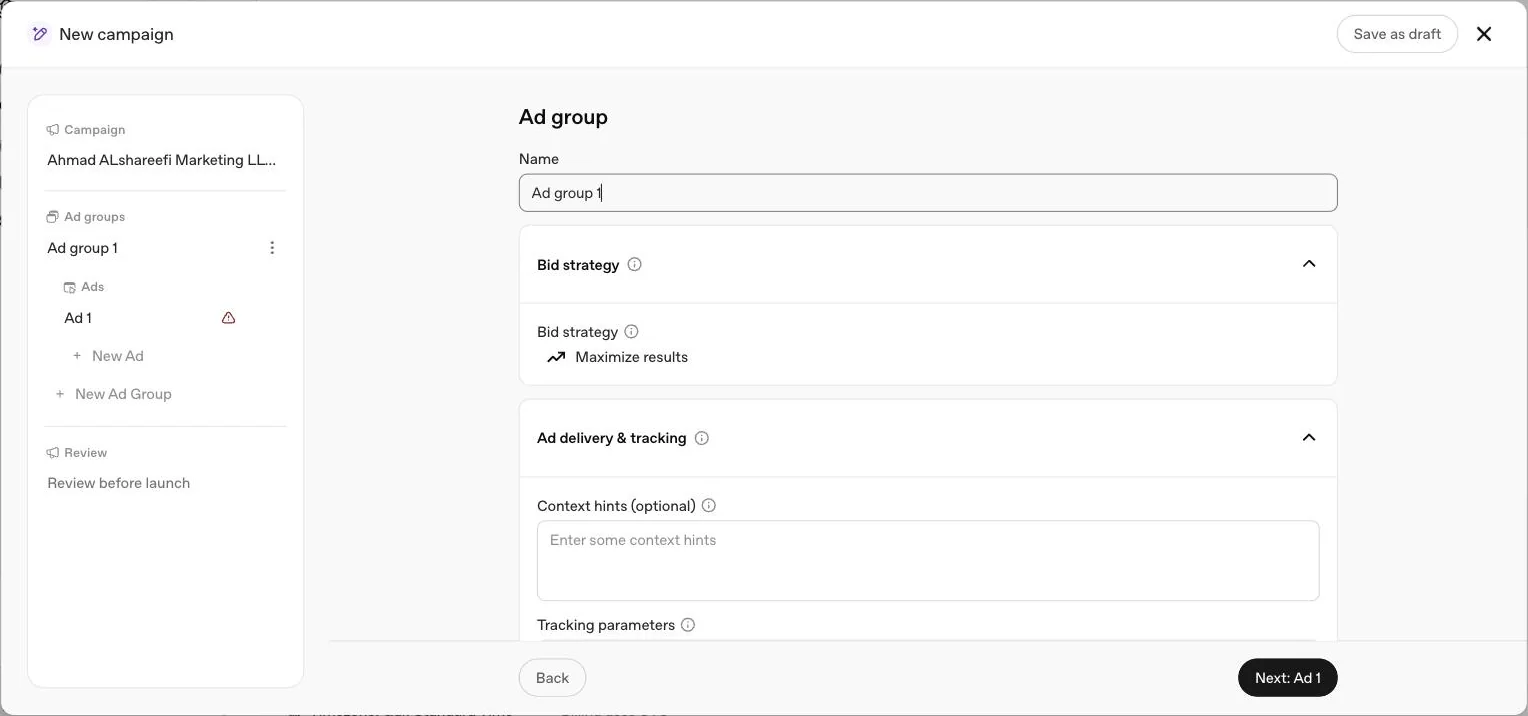
| What you write to target | Keyword lists, negatives | Natural language context hints at ad group level |
| Negative targeting | Negative keywords | Not available as keywords, and hints cannot exclude. OpenAI describes Negative Phrases for narrow brand placement requirements, for qualifying advertisers only |
| Auction | Keyword and Ad Rank based auction | Relevance weighted second price auction |
| Automated bidding | Smart Bidding strategies, widely established | Maximize results, a newer automated bid strategy that optimises toward clicks or conversions |
| Billing | Mostly CPC | CPM, CPC, or conversion optimised on click billing (oCPC) or impression billing (oCPM) |
| Who sees ads | Anyone searching | ChatGPT's unpaid tier and Go plan users. Not Plus and above, not under 18 |
| Sensitive topics | Policy restricted by category | Ads are not eligible near personal health, mental health or politics |
| Measurement | Google tag, enhanced conversions | OpenAI Pixel, Conversions API, oppref click reference |
| Attribution window | Configurable | 7, 14 or 30 day click. Optional 1 day view |
| Campaign structure | Account, campaign, ad group, keyword, ad | Account, campaign, ad group with context hints, ad |
| Platform maturity | Two decades of published benchmarks | Ads Manager opened in May 2026 and is labelled beta |
| UAE minimum daily budget | No fixed platform-wide minimum | AED 65 a day |
What Google Ads gets right that is worth remembering
This is general auction advertising knowledge, not a platform specific claim about either company's numbers. A keyword auction rewards a searcher's own words: someone typing a query has told you what they want in their own language, at the exact moment they want it, and decades of the format have taught advertisers how to read search intent from a handful of words. Quality Score style relevance scoring, in whatever form a platform implements it, exists because an auction that only rewarded the highest bidder would produce worse ads and a worse user experience, and every mature ad auction ends up weighing relevance alongside bid for that reason. ChatGPT ads' relevance weighted auction is the same underlying idea, applied to a much richer signal, a whole conversation instead of a query string.
What carries over from Google Ads
- Measurement discipline. Real events, a server side feed, CRM reconciliation. Identical in principle, different tools. See conversion tracking for ChatGPT ads for the OpenAI specific setup.
- Landing page quality. OpenAI's system reads your landing page as a relevance signal, and it must not block OpenAI's crawlers, OAI-AdsBot and OAI-SearchBot, the same way it must not block Googlebot for search visibility.
- Structure by intent. One ad group per customer need, with its own page. The instinct to segment by what the customer is trying to do, not by product SKU alone, transfers directly.
- Budget discipline over guesswork. Both platforms reward advertisers who size a test to produce enough conversions to judge it, rather than spending the minimum and reading tea leaves from a dozen clicks.
What does not carry over
- Keyword thinking. Pasting a keyword list into context hints misses the point. OpenAI asks for natural phrases about what you offer, who it helps and when, written as a sentence, not a list of fragments.
- One best ad. OpenAI's guidance rewards many distinct variations building coverage, closer in spirit to a large native or display rotation than a tightly optimised single search ad.
- Negatives. You cannot exclude with hints. You control relevance by being specific, and by using the delivery controls that do exist, such as country and platform targeting and custom audiences.
- Editing the objective after launch. On ChatGPT ads, OpenAI says the objective and billing option cannot be changed in place after campaign creation. Google Ads campaigns are generally more forgiving about mid flight changes.
- A visible score you can chase. Google Ads exposes Quality Score as a number advertisers can watch move. OpenAI has not published an equivalent diagnostic; you infer relevance from delivery and bid strength guidance instead.
The intent difference in practice
A Google search says "office fit out dubai." A ChatGPT conversation says the office is 4,000 square feet in Business Bay, the move is in January, approvals are a worry and eight weeks is the limit. An ad that speaks to that situation has more to work with. It also has more ways to be irrelevant, which is why specific copy and specific pages matter more here than they might for a two or three word keyword match.
Building the same campaign on both platforms
| Step | Google Ads Search | ChatGPT ads |
|---|---|---|
| 1. Define the customer need | Keyword research, search volume | Same research, translated into a context hint sentence |
| 2. Structure the account | Campaign, then ad group per keyword theme | Campaign, then ad group per customer need |
| 3. Write the ad | One strong headline, responsive variants | Many distinct title and copy pairs, each a different angle |
| 4. Set the landing page | Match query intent | Match the need described in the context hint |
| 5. Choose billing | CPC, sometimes CPA via Smart Bidding | Views, Clicks or Conversions, chosen once and not editable in place |
| 6. Track it | Google tag or GA4 | OpenAI Pixel and Conversions API, plus UTM parameters |
Common mistakes when running both platforms together
- Reusing Google Ads copy verbatim. A headline written to match a keyword rarely reads as useful inside a conversation. Rewrite for the conversation, do not repurpose.
- Judging ChatGPT ads on platform reported conversions against Google Ads conversions. The two platforms attribute differently. Reconcile both against the same CRM stage before comparing.
- Skipping the crawler check. A landing page allowlisted for Googlebot is not automatically reachable by OAI-AdsBot, particularly behind a WAF that allowlists by name rather than by verified bot list.
- Cutting Google Ads budget to fund the ChatGPT ads test. Fund the test separately. A four week comparison against a channel you just starved is not a fair comparison.
- Expecting Quality Score style diagnostics. OpenAI gives bid strength guidance, not a scored, historical relevance metric you can trend over months the way Quality Score can be trended.
Reporting depth, side by side
Google Ads reporting has had two decades to mature into dozens of segments, scripts and third party dashboards. ChatGPT ads reporting is newer and narrower, but it is not thin. Ads Manager currently reports impressions, clicks, spend, click through rate, average CPC, average CPM and conversions at campaign, ad group and ad level, with table, chart and CSV export views. Attribution is configurable: choose a 7, 14 or 30 day click through window, and optionally add a 1 day view through window, which OpenAI notes uses its existing last touch attribution logic rather than multi touch modelling. Conversions can be split into click through and view through columns, and dynamic URL parameters, including macros for campaign, ad group, ad and account IDs, can be appended to landing page URLs for deeper analytics side tracking. If you compare a Google Ads session count to a ChatGPT ads click count and they do not match, that is expected: the two numbers measure different things, ad interaction versus page load, and OpenAI's own guidance is to compare consistent date ranges and time zones rather than assume the platforms should agree. See measuring ChatGPT ads results for the full reporting walkthrough.
How to split a test budget
Leave Google Ads and Meta untouched. Add a separate ChatGPT budget large enough to produce at least 15 leads or sales in four weeks. Tag it with its own UTM medium. Compare cost per qualified lead or per sale in your CRM, not platform conversions, because the three platforms count differently. Use the budget calculator to size the test against your own numbers rather than a rule of thumb.
OpenAI reports that a technology partner saw more than 80 percent of ad driven ChatGPT traffic come from new customers. That is one partner's figure, relayed by the platform, not an independent study. If it holds for you, ChatGPT ads add reach instead of cannibalising search. Your own new versus returning customer data will tell you, and it is worth checking directly rather than assuming.
Who should test ChatGPT ads first
Businesses with a considered purchase, a clear offer and working lead tracking. Ecommerce stores with a clean product feed, since OpenAI says feed ads have been among the strongest performing format it has seen. Businesses that cannot yet trace a lead to a sale should fix that first, on any platform, because a test that cannot be measured is not a test.
UAE and Gulf specifics
A UAE company already running Google Ads has most of the operational groundwork done: a verified business entity, a working CRM, and staff who understand cost per qualified lead as the real scoreboard. What changes for ChatGPT ads is the account itself. It bills separately in AED with its own AED 65 daily minimum, it is a separate legal setup step even if the same business entity is used, and Google's account structure does not transfer over, since context hints replace keyword lists entirely rather than importing them. Run Arabic and English as separate ads on ChatGPT the same way you likely already run separate Google Ads campaigns or ad groups by language, since each ChatGPT ad carries one title and one copy. The Sunday to Thursday Gulf working week matters more here than on Google Ads, because ChatGPT ads paces a daily budget as an average across a Sunday to Saturday week, not seven days counted from whenever you launched. See ChatGPT ads in the UAE for the full account setup path, or our ChatGPT ads campaign management service if you want both platforms run and reconciled by one team.
Quick answers
Should I move budget from Google Ads to ChatGPT ads?
Not yet. Keep Google Ads as it is and fund ChatGPT ads as a separate four week test. Move budget only after your own CRM shows a better cost per qualified lead or sale.
Do ChatGPT ads have keywords and match types?
No. You write context hints, which OpenAI says are not exact match keywords and do not guarantee delivery in specific conversations.
Can I use my Google Ads conversion tracking for ChatGPT ads?
No. ChatGPT ads use OpenAI's own Pixel and Conversions API. UTM tags on your URLs do carry through, so your analytics can still see the traffic. OpenAI also documents connecting Google Analytics 4 to Ads Manager, but it says imported GA4 totals are not campaign attributed conversions.
Which is cheaper, ChatGPT ads or Google Ads?
There is no reliable UAE comparison yet. OpenAI suggests starting CPC bids of 3 to 5 US dollars, but real cost depends on the auction and your relevance. Measure both in your own CRM.
Does ChatGPT ads have an equivalent to Google's Quality Score?
Not one OpenAI has named or published mechanics for. OpenAI's auction is described as relevance weighted and second price, and relevance comes from your ad, landing page and context hints, which is a similar idea in spirit but not a published, scored metric like Quality Score.
Can I run the same landing page for both platforms?
You can, but OpenAI's crawlers, OAI-AdsBot and OAI-SearchBot, must also be able to reach it. A page already tuned for Google's crawler and ad review is not automatically reachable by OpenAI's, especially behind a WAF or CDN with an allowlist.
Does ChatGPT ads support automated bidding like Google's Smart Bidding?
OpenAI offers Maximize results, a bid strategy that automatically sets and adjusts bids toward a selected goal such as clicks or conversions, and it is the default for eligible new ad groups. OpenAI states it prioritises result volume and does not guarantee a specific cost target.
Related
ChatGPT ads cost in AED
OpenAI publishes no rate card. Here is what it does publish: billing by objective, a suggested starting CPC bid, the AED 65 daily minimum and how budgets really pace.
Context hints
Context hints replace keywords in ChatGPT ads. What OpenAI says they are, how they differ from keywords and traditional targeting, five patterns and UAE examples.
Conversion tracking
oppref is the click reference OpenAI adds to ChatGPT ad landing URLs. How the Pixel stores it, why Pixel plus Conversions API beats either alone, and WhatsApp sales in the UAE.