
OpenAI publishes no rate card. Here is what it does publish: billing by objective, a suggested starting CPC bid, the AED 65 daily minimum and how budgets really pace.
On this page
- The short version
- How you are billed
- The one price signal OpenAI gives
- What ChatGPT ads actually cost in practice
- Where ChatGPT ads appear, and why that keeps cost honest
- The auction in plain words
- Two ways to set your bid
- Minimum daily budgets
- How a daily budget is really spent
- Campaign total budgets cost differently
- Sizing a UAE test
- What moves your price up or down
- Agency versus in-house cost
- Common mistakes when budgeting for ChatGPT ads
- How cost is measured and reported
- Costs outside the platform
- A short glossary of cost terms
- What OpenAI has not published
- Gulf minimums at a glance
- A first 30 days budget plan
- UAE and Gulf specifics
- Quick answers
The short version
Nobody can quote you a fixed price, because there is not one. Cost comes out of an auction. What OpenAI does publish is how you are billed, a suggested starting bid, the minimum daily budget in each currency, how daily budgets pace over a week and what you can and cannot control on a self serve account. Those pieces are enough to plan a test and read the bill correctly once it starts, and this guide covers every one of them, plus where ads actually appear, what drives cost up or down, how agency and in-house management costs compare in general terms, and what OpenAI has simply not published yet.
How you are billed
| Objective | Billing | Bid you set |
|---|---|---|
| Views | Per 1,000 impressions served | Maximum CPM bid |
| Clicks | Per valid click | Maximum CPC bid |
| Conversions, click billing (oCPC) | Per valid click, optimised toward a conversion event | Bid Cap per conversion |
| Conversions, impression billing (oCPM) | Per 1,000 impressions, optimised toward a conversion event | Bid Cap per conversion |
Bids are set at ad group level, inside a campaign that has already committed to one objective. OpenAI states the campaign objective and billing option cannot be changed in place after campaign creation. Choosing wrong means building a new campaign (or, to move a conversion campaign from click billing to impression billing, cloning it), not editing the old one. See our full bidding strategies guide for how Bid Cap, maximum CPC and Maximize Results actually behave.
CPM or CPC: which should you choose
This is our own framing on top of OpenAI's three objectives and their billing options, not an OpenAI recommendation. Choose Views, billed per 1,000 impressions, when the goal is reach and brand exposure and you are comfortable paying regardless of whether anyone clicks, which fits the Dubai restaurant group scenario further down this guide. Choose Clicks, billed per valid click, when the goal is traffic to a specific page and you only want to pay when someone actually engages. Choose one of the two Conversions options once a supported conversion event is already tracked, so delivery optimises toward a lead or a sale rather than a click alone. A UAE business testing the platform for the first time, with tracking not yet proven, is usually better starting on Clicks, since it is billed on an action a person actually took, before moving to a Conversions objective once a conversion event has been confirmed to fire correctly.
The one price signal OpenAI gives
For CPC campaigns OpenAI recommends starting with a maximum bid of 3 to 5 US dollars per click. At the fixed dirham peg of 3.6725 that converts to roughly AED 11 to 18.
Read it for what it is. A suggested starting maximum bid from the platform, written in US dollars, for a US centred beta. It is not a UAE average and it is not what you will pay. The auction is second price and relevance weighted, so a more relevant ad can win at a lower cost than a less relevant one bidding higher. OpenAI says Ads Manager may also provide bid strength guidance that indicates whether a given bid is likely to be competitive or may limit delivery.
How to set your starting bid
This is our own working method, not an OpenAI rule. Start a Clicks campaign near the middle of OpenAI's published range, around 4 US dollars, roughly AED 15, rather than at either edge. Watch the ad group's bid strength guidance during setup; if it flags the bid as likely to limit delivery, that is the platform telling you before you spend anything, not after. Run at least a week before changing the bid at all, since a single day tells you almost nothing and a daily budget itself is a seven day average, covered below. Only then move the bid, and move it in one direction at a time so you can tell whether the change, not something else, caused the result.
What ChatGPT ads actually cost in practice
We would rather say nothing here than invent a number. OpenAI publishes no rate card and no CPC or CPM benchmark, only the $3 to $5 USD starting suggestion above. Our own UAE account was still completing setup when this guide was first written on 21 September 2026, so we had no live spend data of our own to report either, and would flag it clearly as ours, not a platform figure, if we did. OpenAI's own FAQ is direct about this for the whole platform, stating plainly that as an early platform it does not yet have performance benchmarks across advertisers, industries or campaign types. Anyone quoting you a fixed AED number per click as a ChatGPT ads benchmark is quoting a guess, not a published figure.
Where ChatGPT ads appear, and why that keeps cost honest
Ads appear below a ChatGPT response, clearly labelled and shown separately from the answer itself, in one ad unit made of advertiser name, favicon, title, copy, landing page and image; OpenAI says that unit may contain one or multiple images. OpenAI is also testing a multi image ad format shown while ChatGPT generates an image. There is no separate search results page, no display network and no feed of unrelated content to bid into; every ad sits next to something the user asked for, an answer or an image being created. That matters for cost because it removes a whole category of low quality inventory that a bid alone can buy on other platforms. If your ad is a poor match for the conversation, OpenAI's relevance weighting works against you at that exact moment, not in a separate, cheaper corner of the placement; there is no discount seat.
OpenAI is also explicit that ads never appear in Temporary Chats, never influence ChatGPT's answers, and are not eligible to appear near sensitive topics, including personal health, mental health or politics, and that ads do not run for users on Plus, Pro, Business, Enterprise or Edu plans. None of this changes what you are billed for a click or an impression, but it does mean the inventory your bid is competing for is narrower and more deliberately curated than an open web ad exchange, which is part of why OpenAI frames its ranking as balancing advertiser value against user value rather than selling the highest bidder the placement outright.
The auction in plain words
When more than one ad is eligible for a moment in a conversation, OpenAI weighs relevance together with the bid to decide which ad shows. OpenAI names this a relevance weighted, second price auction, stating its system aims to maximise both advertiser and user value. OpenAI does not publish the exact formula, but the general mechanics of a second price auction are well established: the highest ranked bidder wins the placement but is charged close to what the next best eligible ad would have justified, not their own full bid, and relevance weighting means the ranking is not simply the highest dirham amount. Two consequences follow from that. A high bid on a vague, generic ad can still lose to a fair bid on a specific, well matched one. And every improvement in relevance, from sharper context hints to a landing page that matches the ad's promise, can lower what you pay for the same position, because a more relevant ad needs less bid to clear the same bar. OpenAI's own troubleshooting guidance is direct about the other side of this: raising your bid does not guarantee delivery.
| If you see this | Likely cause | What to check first |
|---|---|---|
| Cost per click looks high in week one | Small sample size, or a broad, under-specific ad group | Wait for a full seven day cycle before judging; tighten context hints |
| Delivery stays low despite a raised bid | Relevance, not bid size, is the limiting factor | Ad variety, context hint specificity, landing page match to the ad's promise |
| Spend shows zero right after launch | Reporting delay, not a lack of charges | OpenAI states impressions, clicks and CTR refresh about every 15 minutes, while spend may be delayed 7 to 8 hours; check spend again later that day |
| Cost jumped after an ad was edited | A resubmitted ad re-enters review and can briefly change the delivering mix | Compare cost over the full week, not the day of the edit |
Two ways to set your bid
You are not stuck manually guessing a number. OpenAI's Ads Manager offers two bid strategies at ad group level.
| Strategy | How it works | Best fit |
|---|---|---|
| Manual: Max bid | You set the maximum bid per click or per 1,000 impressions, or a Bid Cap per conversion on a conversion campaign | You have a specific bid limit you need to stay within |
| Maximize Results | ChatGPT Ads sets and adjusts bids automatically toward your selected campaign goal | You want the most results from a fixed budget and are willing to let bids move |
Maximize Results is selected by default for eligible new ad groups. OpenAI states plainly that it prioritises result volume and does not guarantee a specific CPA, CPC or ROAS. If you have a specific bid limit to stay within, OpenAI points to the manual or advanced bid controls instead. The mechanics of both, including Bid Cap for conversion campaigns, are covered in the bidding strategies guide.
Minimum daily budgets
The minimum varies by the currency your ad account bills in, not by country of the user you are targeting.
| Billing currency | Minimum daily budget |
|---|---|
| AED | 65 |
| SAR | 50 |
| QAR | 60 |
| USD | 25 |
| EUR | 15 |
| GBP | 15 |
| INR | 725 |
| ILS | 60 |
These are a selection; OpenAI's table lists 30 billing currencies. The currency is fixed when the account is created and, per OpenAI, is tied to the billing country and legal entity on the account. One more rule applies specifically to fixed bidding: the daily budget must be at least as high as the highest effective bid across the campaign's non archived ad groups, including any audience bid adjustment. Set the bid, then the budget, or the budget field will refuse a number that is too low. OpenAI's own example makes the mechanics concrete: an effective ad group bid of $250.50 prevents setting that campaign's daily budget below $250.50 until the bid is lowered; that is not a universal platform minimum, only the consequence of one specific bid.
A UAE minimum of AED 65 a day is a floor for one active campaign, not a budget that on its own produces a judgable test. At the suggested starting bid of roughly AED 11 to 18 per click, AED 65 a day buys somewhere between about 4 and 6 clicks before the daily allowance is used, which is too thin a sample to read cost per click from reliably inside a single day, even before accounting for the seven day averaging below. Treat the minimum as what unlocks a campaign, not as a serious test budget.
How a daily budget is really spent
This catches people out more than any other rule on the platform. OpenAI treats the daily budget as an average across seven days, not a per day ceiling.
- A single day can bill up to twice the daily budget.
- Across the seven day period, spend will not exceed seven times the daily budget.
- If delivery is light on one day, the unused amount can be used later in the same seven day period.
- The budget week runs Sunday to Saturday in the account's own time zone. A mid week change to the budget is prorated from the moment of the change through to the next Sunday at midnight.
- OpenAI's own worked example: a seven day campaign with a 100 US dollar (about AED 367) average daily budget has a total media spend ceiling of 700 US dollars (about AED 2,570) for that week.
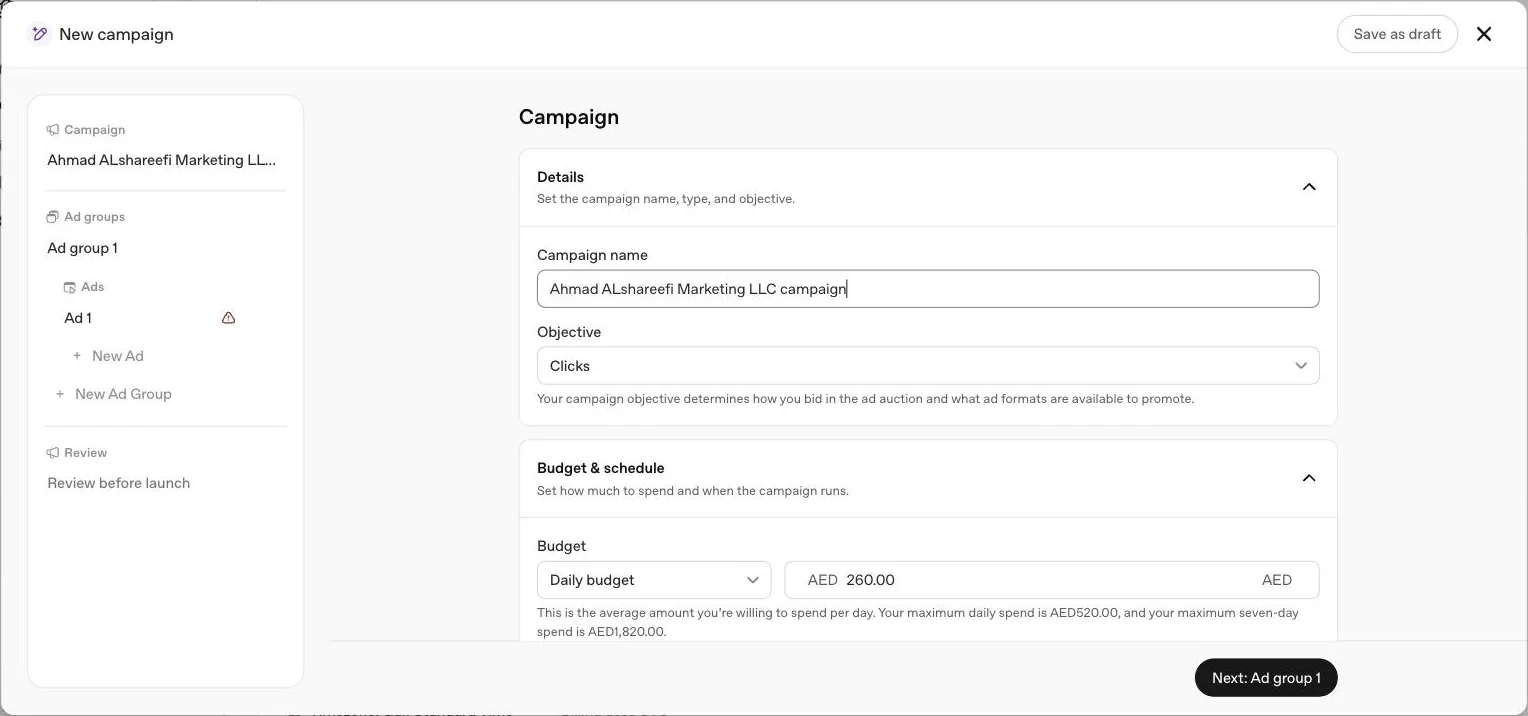
With an AED 250 daily budget, one strong day can bill up to AED 500, and the total for the Sunday to Saturday week will not pass AED 1,750. We saw this rule written directly into the interface on our own account on 21 September 2026: entering an AED 260 daily budget in the campaign builder produced helper text spelling out that figure as the average daily amount, alongside a maximum daily spend of AED 520 and a maximum seven day spend of AED 1,820, exactly twice and seven times the entered figure. Plan cash flow on the weekly number, not the daily one. The full mechanics, including what happens when you raise or lower the budget mid week, are in our dedicated daily budgets and pacing guide.
Campaign total budgets cost differently
A campaign total budget is a ceiling for the whole campaign's life rather than an average per day. Ads Manager paces spend against it using your remaining budget and, where you set one, your end date. OpenAI recommends setting an end date because pacing without one defaults to a 60 day planning window, which can spread a budget thinner than you intended. If a campaign is spending ahead of pace, delivery can slow to preserve budget for later; if it is behind pace, delivery can continue so it has a chance to catch up. Neither behaviour is a spending guarantee, and changing your bid strategy does not override total budget pacing on its own.
For predictable weekly cash flow, a daily budget is easier to reconcile against an invoice. For a fixed campaign spend that must not be exceeded, a campaign total budget is the stricter control. You can change a campaign total budget to a daily budget after creation, but OpenAI is explicit that you cannot then switch that campaign back to a campaign total budget; if the budget type is wrong, OpenAI says to create a new campaign.
For a campaign total budget with an end date, OpenAI paces spend over the time remaining until that date, up to a maximum pacing period of 365 days. Without an end date, pacing defaults to 60 days, which on a large budget can mean spend trickles out far more slowly than a four week UAE test needs; set an end date deliberately rather than leaving pacing to guess your intended duration. Note too that the end date is the latest date a campaign can deliver, not a promise the budget lasts that long: a campaign can exhaust its total budget earlier if delivery is strong.
Sizing a UAE test
Work backwards from outcomes, not from the minimum. You need enough leads or sales to compare fairly against Google and Meta, and fewer than about 15 conversions in a test period tells you very little.
| Input | Example A | Example B |
|---|---|---|
| Daily budget | AED 250 | AED 500 |
| Days | 28 | 28 |
| Total | AED 7,000 | AED 14,000 |
| Assumed cost per click | AED 12 | AED 12 |
| Clicks | About 580 | About 1,166 |
| Click to lead rate | 5 percent | 5 percent |
| Leads | About 29 | About 58 |
The cost per click and lead rate in both columns are assumptions used only for the arithmetic. They are not OpenAI benchmarks and not a promise of what you will get. Put your own numbers into the budget calculator once you have a week or two of real data.
Worked examples by business model
These are illustrations built on assumed inputs for the arithmetic only, not OpenAI figures or a promise of results. Swap in your own numbers once real data exists.
| Business | Objective | Daily budget | 28 day total | Assumed CPC | Assumed conversion rate | Result over 28 days |
|---|---|---|---|---|---|---|
| Aesthetics clinic, lead form | Conversions, oCPC | AED 300 | AED 8,400 | AED 14 | 6 percent form fill | About 600 clicks, about 36 leads |
| Online perfume store | Product feed, Maximize results | AED 400 | AED 11,200 | AED 10 | 2 percent purchase | About 1,120 clicks, about 22 orders |
| B2B software company | Conversions, oCPC to a demo booking | AED 250 | AED 7,000 | AED 16 | 4 percent demo booking | About 437 clicks, about 17 demos |
| Dubai restaurant group | Views, brand awareness | AED 200 | AED 5,600 | CPM basis, not CPC | Not applicable | Impressions bought at a set CPM, no click assumption needed |
The restaurant group row is deliberately different: a Views campaign is billed per 1,000 impressions, so there is no cost per click or conversion rate to assume at all, only a CPM you set as your ceiling.
What moves your price up or down
OpenAI names relevance and the bid as the two inputs to the auction, and relevance is mostly in your hands.
| Lever | Why it moves cost | Source |
|---|---|---|
| Context hint specificity | A hint describing a concrete need helps the system match your ad to the right moment instead of competing broadly | OpenAI's context hints guidance |
| Number of distinct ad variations | More coverage per offering helps the system find more moments where an ad is genuinely relevant | OpenAI's ad creation guidance |
| Landing page match to the ad's promise | Ad review checks alignment between the two; a mismatch that gets an ad rejected costs the whole test, not a few dirhams | OpenAI's landing page and ad policy guidance |
| Bid strategy choice | Manual bidding caps cost per unit but can limit volume; Maximize results spends toward volume without a cost guarantee | OpenAI's Maximize Results documentation |
See writing context hints for OpenAI's own wording guidance on the first lever.
Agency versus in-house cost
This section is our own view of the general market, not an OpenAI publication and not a statement of our own fees.
| Model | How it is charged | Where it tends to suit a UAE advertiser |
|---|---|---|
| Percentage of spend | A share of media spend, on top of what is paid directly to OpenAI | A business still discovering its right budget, comfortable with the fee scaling as spend does |
| Fixed retainer | A flat monthly amount regardless of spend level | A business that already knows roughly what it wants to spend and wants the fee tied to output, not budget size |
A percentage model scales automatically as a UAE budget grows, but it also means the agency's fee rises even if the extra spend is not producing proportionally more leads. A fixed retainer keeps the management cost predictable and separate from the media decision. Either way, the agency fee is separate from media spend; media is paid by the advertiser directly to OpenAI under the postpay model in our billing guide, never routed through the agency's own account.
Common mistakes when budgeting for ChatGPT ads
How cost is measured and reported
Ads Manager's core cost metrics are spend, average CPC and average CPM, alongside impressions, clicks and CTR, all available at campaign, ad group and ad level in table view, chart view or CSV export. OpenAI states impressions, clicks and CTR refresh about every 15 minutes, while spend may be delayed 7 to 8 hours, so a displayed spend of zero shortly after launch does not necessarily mean nothing has been charged; average CPC and average CPM depend on settled spend and can update later still. If a cost figure in your own analytics does not match Ads Manager, OpenAI points to several ordinary causes before assuming an error: different attribution methods or windows, different time zones or date boundaries, browser or consent settings affecting what could be measured, and different deduplication behaviour between systems. For UAE businesses that close leads over WhatsApp or by phone rather than on a web page, cost per result depends entirely on getting those events into measurement in the first place; a cost per click looks fine while a cost per actual sale stays invisible if a phone close is never recorded as a conversion event. Our conversion tracking guide covers the method for capturing those.
Costs outside the platform
| Cost item | Who it is paid to | Notes |
|---|---|---|
| Media spend | OpenAI directly, by card | Postpay model, charged when the account reaches its payment threshold or at month end |
| Creative production | Your own team or supplier | Titles, copy and images against OpenAI's specs, in English, Arabic or both. On our own account on 21 September 2026 the ad step enforced a 50 character title counter, a 100 character description counter with a 3 character minimum, and a square image of at least 256 by 256 pixels; OpenAI's developer documentation now asks for an ad image of at least 640 by 640 pixels |
| Landing pages | Your own team or supplier | Must be reachable and not block OAI-AdsBot or OAI-SearchBot |
| Tracking setup | Your own team, supplier or agency | Pixel, Conversions API and, for non web leads, a way to log WhatsApp or phone conversions |
| Ongoing management | An agency, if you use one | Separate from media spend; see agency versus in-house below |
Media is paid by you directly to OpenAI by card, on the postpay model covered in our billing guide. The item most often left out of a first test budget is measurement, and it is the one that decides whether the test can be judged at all once it ends. Set up conversion tracking before you launch, not after. One creative cost item is worth a deliberate decision rather than a default: the campaign builder's Text customisation toggle, on by default when we saw it in our own account on 21 September 2026, lets AI personalise and translate your headline and description text automatically, which can genuinely reduce the time spent producing English and Arabic variations, but the toggle's own description in the interface said this text may run without your individual review, so weigh that trade off before leaving the default in place.
A short glossary of cost terms
What OpenAI has not published
No rate card, no CPC or CPM benchmark, no industry or vertical cost comparison, and no stated relationship between bid strength guidance and an actual price. There is also no published recommended bid for Bid Cap on conversion campaigns; OpenAI states plainly there is no recommended amount at this time, so it is set from your own numbers. There is no published typical cost impact of running an ad in Arabic versus English, no published seasonal cost pattern for the UAE market, and no confirmation of exactly how the second price mechanic is calculated once relevance weighting is applied. Where this guide gives a number that is not one of OpenAI's own, such as the middle starting bid suggestion or the worked business examples above, it is labelled clearly as ours, not OpenAI's.
Gulf minimums at a glance
| Market | Billing currency | Minimum daily budget |
|---|---|---|
| United Arab Emirates | AED | 65 |
| Saudi Arabia | SAR | 50 |
| Qatar | QAR | 60 |
| Israel | ILS | 60 |
| India (for reference) | INR | 725 |
These are set by the ad account's billing currency, fixed at account creation, never by the country of the person who sees the ad. A UAE entity running Gulf wide campaigns from one AED billed account still pays the AED 65 floor, not a blended one; a separate account billed in SAR or QAR would carry that market's own minimum instead.
A first 30 days budget plan
This is our own approach, not an OpenAI recommendation. Set the daily budget at a level you can hold steady for the full period without touching it out of nerves; changing a campaign's daily budget mid week reprorates the weekly cap, and changing it too often makes the resulting cost per click hard to read. In week one, spend at the minimum viable level for your objective and resist judging cost per click before a full seven day cycle has completed, since the daily budget is an average over that period, not a daily promise. In weeks two and three, hold the budget steady and add ad variations rather than moving the bid, since OpenAI's own ad guidance points to a high volume and diverse set of ads as the way to find more moments where an ad is relevant. In week four, compare the full month's cost per result against your other channels using the same attribution window and time zone on both sides, then decide whether to raise the budget, tighten the ad group, or stop.
UAE and Gulf specifics
Your ad account's billing currency, not the country of the person seeing the ad, sets your minimum daily budget. A UAE entity billing in AED starts at AED 65 a day. If you later open a Saudi Arabia focused account, the minimum there is SAR 50; Qatar is QAR 60. OpenAI's published minimum table does not separately list Bahrain, Kuwait or Oman, so confirm the actual minimum shown inside Ads Manager at setup if you bill in one of those currencies rather than assuming a figure. OpenAI notes that new self serve accounts can initially advertise only in their home country until identity verification is approved and the account has spent enough there, so budget your first weeks for the UAE alone even if the wider plan is Gulf wide.
The budget week runs Sunday to Saturday in the account's own time zone, which happens to line up with the UAE's own Sunday start to the working week. If your finance team reconciles spend on a Sunday, that is also the day OpenAI's own weekly spending cap resets. Cost has one more UAE specific wrinkle worth planning for: OpenAI does not publish a language restriction, so running separate English and Arabic ads inside the same ad group means more creative to produce, not a different price per click, since billing is set by the objective and the auction, not by the language of the ad.
If you would rather have a budget planned and set up for you, see our campaign management service, or get in touch to talk through a UAE test budget.
Quick answers
How much does a click cost on ChatGPT ads?
There is no rate card. Price is set by a relevance weighted second price auction. OpenAI recommends starting CPC campaigns with a maximum bid of 3 to 5 US dollars per click, which is roughly AED 11 to 18 at the fixed dirham peg.
What is the minimum daily budget in the UAE?
AED 65 per day for ad accounts billed in dirhams. Neighbouring Gulf accounts differ: SAR 50 in Saudi Arabia and QAR 60 in Qatar.
Can ChatGPT ads spend more than my daily budget?
Yes, on a single day. OpenAI treats the daily budget as an average over seven days. One day can reach twice the daily budget, and the seven day total will not exceed seven times the daily budget.
Do I pay per lead or sale?
No. Conversion optimised campaigns are billed per valid click or per 1,000 impressions. OpenAI states you do not pay per conversion, even though delivery is optimised toward one.
Does a higher bid guarantee my ad shows?
No. OpenAI's own troubleshooting guidance says raising your bid does not guarantee delivery. The auction weighs relevance alongside the bid, so a more relevant, better matched ad can still win.
What is the cheapest way to test ChatGPT ads?
Start a single campaign at the AED 65 daily minimum with a Clicks objective, run it at least a week so the seven day averaging has room to work, then judge cost per click before scaling the budget.
Does Maximize Results cost more than manual bidding?
OpenAI does not publish a comparison. Maximize Results is designed to spend your existing budget toward more results, not to raise what you spend. See our bidding strategies guide for how it changes bid setting, not budget.
Where do ChatGPT ads actually appear, and does that affect cost?
Below a ChatGPT response, clearly labelled, in one ad unit that may contain one or multiple images. OpenAI is also testing a multi image ad format shown while ChatGPT generates an image. There is no display network or cheap placement to buy into, so a poorly matched ad competes at full relevance weighting rather than finding a discount corner.
Does an agency cost extra on top of ad spend?
Media is always paid directly to OpenAI by the advertiser. An agency's own fee, whether a percentage of spend or a fixed retainer, is a separate line item on top of that, not part of what OpenAI bills.
Why does my cost per click look different from my own analytics?
Different attribution windows, time zones, consent settings and deduplication logic between Ads Manager and your analytics tool are the most common causes OpenAI points to, before assuming either figure is wrong.
What does OpenAI publish about typical ChatGPT ads cost by industry?
Nothing. OpenAI states ChatGPT Ads does not yet have performance benchmarks across advertisers, industries or campaign types, since the platform is still early in scaling.
Related
ChatGPT ads in the UAE
The UAE is on OpenAI's self service list. Who qualifies, the AED 65 daily minimum, how billing and account setup work and a four week test plan.
Conversion tracking
oppref is the click reference OpenAI adds to ChatGPT ad landing URLs. How the Pixel stores it, why Pixel plus Conversions API beats either alone, and WhatsApp sales in the UAE.
What ChatGPT ads are
Where ChatGPT ads appear, what an ad contains, how OpenAI picks which ad to show, who sees them, how campaigns are structured and what advertisers can never know.
Daily budgets and pacing
A daily budget is a seven day average, not a per day cap. How OpenAI paces daily and campaign total budgets, worked in AED, with the rules that trip up new advertisers.
Bidding strategies
Manual max bid, Maximize Results and Bid Cap for conversions. How OpenAI's relevance weighted auction actually decides what wins, and when each bid strategy fits.